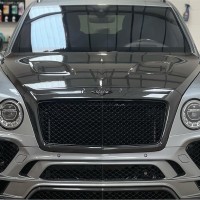
Why New Cars Need Paint Correction
By Alex, Improve Details · Published 9 September 2026 · Last updated 5 October 2026
Do new cars really need paint correction?
Yes — around 95% of new cars have minor paint defects when they reach their owner. Factory finishing, transport, storage and dealer preparation each leave their mark: holograms, wash marring and light scratches that you'd never expect on a brand-new car. New-car paint correction removes these defects so your protection — ceramic coating or PPF — locks in a flawless finish, not someone else's mistakes.
Where new-car paint defects come from
Factory and transport
Cars travel a long way before they reach you — often across continents. They're moved, stored, shipped and shunted, picking up light scratches, rail dust and industrial fallout on the way. Protective transit wrapping helps, but it doesn't prevent everything, and its removal can mark the paint.
Dealer preparation and PDI
Pre-delivery inspection (PDI) is where much of the damage happens. Cars are washed quickly — often with the same mitt that's washed a dozen cars — and "detailed" by staff whose priority is speed, not paint care. Rotary polishers in hurried hands leave holograms and buffer trails: wavy, oily-looking marks visible in sunlight. This is the single most common defect we correct on new cars.
The complimentary dealer wash
That free wash before collection? Politely decline it. It's one of the biggest sources of new-car swirl marks. Ask for the car unwashed, or better still, arrange for it to come straight to a detailer. The first wash a car receives sets the tone for its paintwork for years.
What new-car paint correction involves
New-car correction is usually lighter than correction on a used car — the defects are fresh and shallow. It's typically a careful single-stage enhancement or a light two-stage paint correction: wash and full decontamination (iron fallout, tar, clay), paint thickness measurement, machine polishing to remove the defects, panel wipe, and inspection under dedicated lighting. Then — and only then — protection goes on.
Correct first, then protect
Correction and protection are a package. There's no point sealing defects under a coating or film:
- Ceramic coating adds a durable hydrophobic layer with deep gloss, UV and chemical resistance, and much easier washing — ideal for keeping a new car looking new with minimal effort.
- Paint protection film (PPF) is a self-healing film that physically protects against stone chips and scratches — the right choice if your new car will live on motorways.
- Many new-car owners combine the two: PPF on the high-impact front end, ceramic coating over the rest (and over the film).
See our new-car paint correction and protection page for the full bundle.
Book before the dealer washes it
The ideal time to talk to us is before you collect the car. We can advise you what to tell the dealer (no wash, no "complimentary detail"), and book your correction and protection for as soon as possible after collection. Every week a new car spends being washed badly is a week of defects we'll need to correct.
What we typically find on a new car
Every new car is different, but the defect list is remarkably consistent:
- Holograms on the bonnet and boot — from hurried dealer machine polishing.
- Wash marring on the doors and wings — from transport and storage washes.
- Light scratches around the door handles — from PDI checks and delivery drivers.
- Iron fallout on lower panels and wheels — picked up in transit and storage compounds.
- Adhesive residue — from transit wrapping and protective films.
None of this means the car is seriously damaged — it's all shallow, and it's all correctable. But it's the reason a new car rarely looks its best on collection day.
The cost of skipping correction
It's tempting to go straight to protection and skip the correction step. The problem is that coatings and films are optically clear — they magnify what's underneath rather than hiding it. Holograms under a ceramic coating are still holograms; they're just glossier holograms now, sealed in for the life of the coating. Correcting later means removing the protection first and starting again, which costs more than doing it properly in the first place. Correction first is the economical choice, not the extravagant one.
Improve Details is based on Lilford Street in Warrington (WA5 0LE) and prepares new cars for owners across Warrington, Cheshire and the North West. Call 07933 498857 or WhatsApp 07482 225323 — tell us the make, model and collection date and we'll plan the protection around it.
Related services
Frequently asked questions
My car is brand new — why does the paint need correcting?
Because new doesn't mean perfect. Around 95% of new cars have minor defects from the factory, transport or dealer preparation — holograms, wash marring and light scratches. Correction removes them before protection locks them in.
Should I let the dealer wash or detail my new car?
Politely decline. Dealer washes are one of the biggest sources of new-car paint damage — quick washes with dirty mitts and harsh brushes instil swirls before you've driven a mile. Ask for the car unwashed, or book it straight to us.
Is it better to protect a new car with ceramic coating or PPF?
It depends on how you use the car. Ceramic coating gives gloss, hydrophobics and easier washing; PPF physically protects against stone chips. Many new-car owners choose PPF for the front end and ceramic coating elsewhere. Both need corrected paint underneath first.
When should I book new-car paint protection?
As soon as possible after collection — ideally before the car sees an automatic car wash or a dealership wash bay. The longer paint goes unprotected, the more wash damage it collects.
Have a question about your car's paint?
Call 07933 498857, message us on WhatsApp, or send photos of your car for honest advice and a quote.
Prefer WhatsApp? Message 07482 225323 with photos of your car for a faster, more accurate quote.